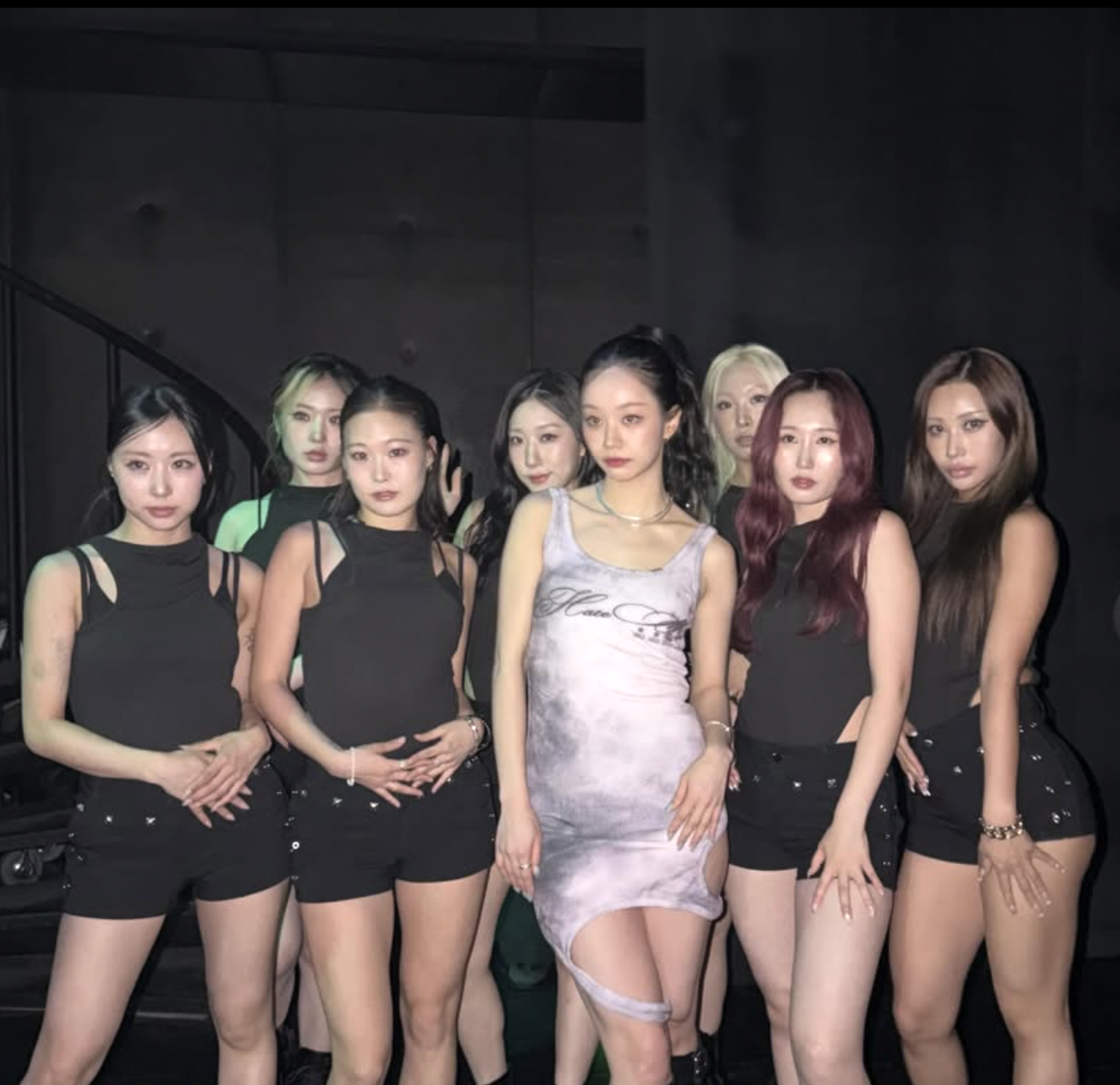
(Photo = HYERI Instagram)
[Hanteo News = Reporter JUNG JUNHWA] HYERI directly spoke up about the so-called “belly fat controversy.” It was not an explanation, but a message toward society. She did not pour out a sense of unfairness after being swept up in gazes surrounding her body, nor did she try to calm the controversy by putting forward a will to manage her appearance. Instead, HYERI calmly accepted the attention directed at her, while choosing to question what that gaze itself was premised on.
The controversy began after her solo fan meeting held at Samsung Hall of Ewha Womans University in Seoul on the 13th. After the fan meeting highlight video was released, reactions spread online saying that HYERI’s abdominal line appeared noticeable in some stage scenes where she wore a form-fitting dress. The so-called “belly fat controversy” that began this way quickly turned into body evaluation, and as if it were familiar, some began judging her appearance.
However, the core of this issue was not whether her body had actually changed. A tight outfit, a specific angle in the video, and an optical illusion created by the silhouette led to excessive interpretation, making it closer to an incident in which the culture of evaluating a female celebrity’s body reared its head once again. At the same time, there were also many reactions saying it only looked that way because of the outfit’s silhouette, pattern, and material. In the end, what the controversy revealed was not “whether her stomach stuck out or not,” but how easily the public turns a female star’s body into an object of scrutiny.
HYERI’s response at this point was meaningful. Through a fan communication platform, HYERI opened up, saying, “Honestly, I like myself, but people watching may think I’m not professional.” She then added, “(But I don’t know why you have to be slim to seem professional).” This was the most striking part. Rather than denying or actively refuting the controversy, she quietly shook the social standard that allowed the controversy to exist in the first place.
What does it mean to be “professional”? Is it the attitude with which one carries out a stage, the ability to complete a performance, or the sincerity with which one connects with fans? Or is it some kind of qualification that can only be earned by always existing with a body free of any extra flesh? HYERI’s words brought that long-standing question back to the surface. It was a remark that questioned whether it is truly natural to regard slimness as the absolute standard of self-management and connect it to professionalism.
That does not mean HYERI only set up a sharp confrontation. She also conveyed her feelings toward her fans, saying, “Still, if HYERIMI, the fandom name, wants it, I’ll try. I’ll exercise and do it healthily!” This statement is closer to an expression of her concerns as an artist who understands fans’ expectations, rather than a declaration that she will conform to appearance evaluations. While clearly expressing her own thoughts, she did not push that weight forward solely in her own language within her relationship with fans.
Her words, “We are all beautiful just as we are,” remain like the conclusion of this statement. This sentence goes beyond HYERI’s personal confession of feelings. It is a small but clear objection to the old frame that says only certain body shapes are beautiful, and that failing to meet that standard is connected to a lack of self-management or unprofessionalism. What HYERI seemed to want to say was not “I feel wronged,” but closer to “Why do we evaluate one person’s body this easily?”
Afterward, HYERI took a head-on approach by even revealing other behind-the-scenes photos that exposed her abdomen. Instead of hiding or rushing to patch things up, she chose to show herself as she is. This, too, was closer to a message than an explanation. It was because the person at the center of the controversy showed an attitude of not hiding her own body rather than shrinking back.
This controversy does not end as a simple happening surrounding one person’s body. It is also a case that once again showed how easily the public’s gaze toward female celebrities’ appearances shifts into evaluation and judgment, and how old and firm those standards are. That is why HYERI’s words can be interpreted not as a simple response statement, but as a question that creates a crack in the body scrutiny that had been consumed so familiarly.
In the end, HYERI’s response was not an “explanation.” Facing the controversy surrounding her, she did not try to prove her body. Instead, she asked what kind of standard of “professionalism” society has demanded of women, especially female celebrities. And that question makes us look beyond HYERI herself and reflect on how recklessly the gaze of this era judges the bodies of so many people.
joonamana@hanteo.com
![At the Crossroads of an “11-Year Partnership,” TWICE…JYP’s Contract Renewal Calculus [HT Focus]](/_next/image?url=https%3A%2F%2Fresource.hanteonews.com%2Fcontent%2Fpost%2F2026%2F08%2F12%2F35b97dc0-8727-41b1-8c42-90749efe4645.jpg&w=3840&q=75)
![Not an “Selfish Choice,” But a Desperate Effort for Fans [HT Focus]](/_next/image?url=https%3A%2F%2Fresource.hanteonews.com%2Fcontent%2Fpost%2F2026%2F06%2F02%2F141c6a92-c802-447d-b949-02198d55ef1f.jpg&w=3840&q=75)
![Why a Festival Bearing Stray Kids’ Name Is Being Held in Latin America [HT Focus]](/_next/image?url=https%3A%2F%2Fresource.hanteonews.com%2Fcontent%2Fpost%2F2026%2F06%2F23%2F3b0eaa19-22e7-4397-9c6b-ef7cbb48597d.jpg&w=3840&q=75)

