The 101th K-pop Deep Dive Dictionary Deals with words related to trading K-pop photo cards.
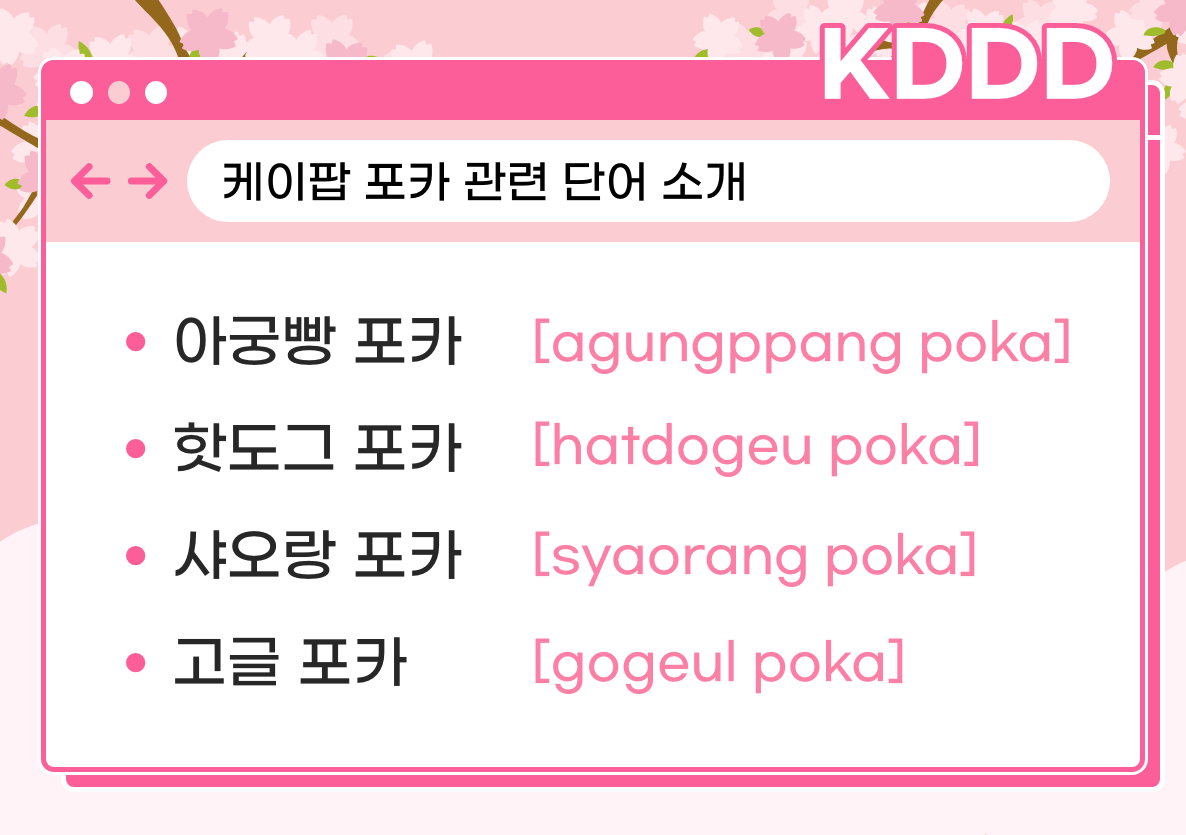
[agungppang poka]
Photo cards taken with the ‘agungppang’ pose, which is a short term for baby butt bread
Fans began to call Doyoung ‘agungppang’ when they saw that Doyoung looked like the baby butt bread purchased by NCT Doyoung during the filming of ‘Omniscient Interfering View’. Since then, Doyoung, who was doing a video call fan signing event, made a pose to collect cheek fat and the fan thought, "This is the ‘agungppang’ pose!" Starting with NCT Doyoung, many K-pop artists used it as a photo card pose, and agungppang photo cards became popular.
자 아궁빵 뜻 유래 알려줄게
— 유비아 (@do0_lluvia) October 5, 2022
전참시 촬영날 도영이가 아기궁뎅이빵이란 걸 샀어 그게 도영이랑 똑 닮아서 팬들이 도영이를! ‘아궁빵’이라고 부름! 근데 영통팬싸에서 볼살을 챱 모으는 포즈를 한 도영이가 아! 이게 아궁빵 ’포즈‘구나! 해서 아궁빵 포즈가 됨
포인트는 볼살을 모으는 거야! 그럼 안녕! pic.twitter.com/Pln6zCIcHx
[hatdogeu poka]
A photo card taken with index finger on the chin, expressing the head as the bread part of the hot dog and index finger as the skewer part of the hot dog
A pose that expresses the head as the bread of a hot dog and the skewer part of a hot dog with the index finger on the chin is called a hatdogeu pose. The origin of the pose is NCT Jungwoo, and it has since been commonly used as a photo card pose among idols. The hatdogeu photo card of NCT Jungwoo, the creator of the pose, was sold at a high asking price.
엔믹스 LMLT 사운드웨이브 사웨 3차 영통 핫도그 포카 미공포 양도합니다
— 대리구매/양도 (@goods_transacts) August 11, 2023
⭕️릴리 해원 설윤 지우⭕️
제시해서 디엠주세요
WTS selling nmixx expergo Love Me Like This soundwave r3 videocall photocard
lily haewon sullyoon jiwoo
DM with your price
❌️how much❌️ pic.twitter.com/K8tEJ8poq7
[syaorang poka]
It means photo cards taken while cosplaying with syaorang, the male character of the animation ‘Cardcaptor Cherry’
It refers to a photo card taken while cosplaying as syaorang, and is widely used in male idol photo cards. Syaorang’s trademarks, hat and scarf catch the eye.
230708 위드뮤 샤오랑 포카🤍#루네이트 #LUN8 pic.twitter.com/5N43z8ax3u
— 하또 (@heartddo) July 22, 2023
[gogeul poka]
It’s a photo card taken with transparent goggles on
It means a photo card taken wearing transparent goggles, which is also famous for water balm preparations. Transparent goggles are used when they are in a strong concept, so they have a strong hip feeling. Therefore, gogeul photo cards give a more hip feeling compared to other photo cards. Gogeul photo cards are perfect when looking for hip photo cards.
고글포카 이거 좋은거네 ...... pic.twitter.com/M1gcTs5Mtv
— 단 (@eric_12S2) August 16, 2023
※ Hanteo Global's K-pop Culture Research Institute aims to create standards for K-pop and make it easier for all K-pop fans around the world to access and enjoy K-pop. As part of that, we launched the ‘K-pop Deep Dive Dictionary’ series, which introduces terms and expressions used only by true K-pop fans. We hope the series will help overseas K-pop fans and the public better understand and communicate with the unique culture of K-pop fans.
![[Daily Ranking: May 17th] NMIXX’s ‘Heavy Serenade’ Places 1st](/_next/image?url=https%3A%2F%2Fhanteoresource.s3.ap-northeast-2.amazonaws.com%2Fhanteonews%2Farticle%2Fthumbnail%2Fbot%2Fchart%2Falbum%2Fdaily%2Fen%2F1st.png%3Fv0.0.1&w=3840&q=75)


