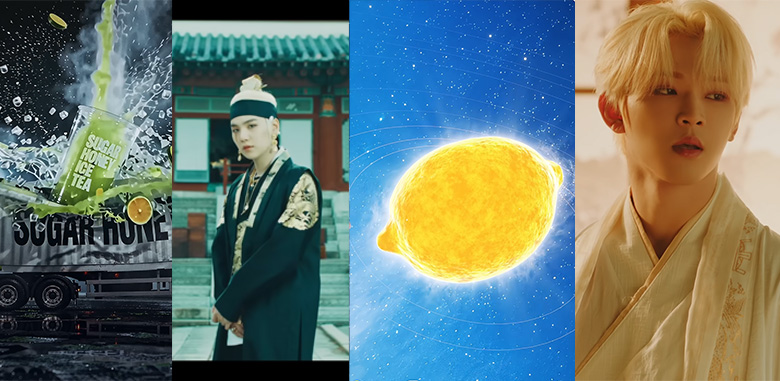
The song titles of recent idol releases are far from ordinary. Words that evoke food, such as lemon, sugar, and ice cream, have been appearing one after another in title track names, drawing listeners’ attention. However, this trend is not only a recent phenomenon. In the K-POP scene, the strategy of capturing both timeliness and emotion through song titles has continued steadily for a long time.
In May, aespa released 'LEMONADE,' signaling a refreshing and cool summer sentiment. On the 8th and 22nd, BABYMONSTER is set to make a comeback with 'SUGAR HONEY ICE TEA,' while Hearts2Hearts will also release new music around the same time with 'Lemon Tang.'
aespa and Hearts2Hearts, in particular, are drawing attention for coincidentally using the same material, “lemon.” Fans are focusing on how the two groups will seek differentiation within their respective concepts and directions while using the same ingredient.
These kinds of song titles that emphasize a refreshing summer feeling are closer to a planning strategy than a simple trend. This is because, at a time when seasonal mood and listeners’ emotional preferences align, the title itself has the effect of imprinting the atmosphere. In fact, artists under SM Entertainment have maintained this direction for a long time. Representative examples include Red Velvet’s 'Red Flavor,' 'Blue Lemonade,' and 'Ice Cream Cake,' as well as EXO’s 'Ko Ko Bop,' which have captured the public’s ears first with song titles that evoke taste and color.
Summer concepts are not limited only to refreshing moods. Songs that put “spiciness” and “heat” at the forefront have also continued to be loved. SEVENTEEN’s 'HOT,' f(x)’s 'Hot Summer,' and NCT DREAM’s 'Hot Sauce' represent this trend. The coexistence of contrasting emotions, coolness and heat, is also a defining feature of K-POP’s summer season.
On the other hand, when timeliness is missed, it can lead to disappointing evaluations. aespa’s 'Dirty Work,' released last year, drew reactions at the time of its release that the atmosphere of the music video, outfits, and overall mood of the song felt hot. It was pointed out that the song was far removed from a refreshing or powerful summer sentiment. This case shows that a mismatch with seasonal mood can affect listeners’ perceived satisfaction, separate from the quality of the song itself.
Another axis of song title strategy is the active use of Korean aesthetics. BTS’ 'ARIRANG,' SUGA’s 'Daechwita,' Stray Kids’ 'DIVINE,' ONEUS’ 'LUNA,' and G-DRAGON’s 'Niliria' are leading this trend.
In their music videos, hanbok and palaces appear as backgrounds, while folk song sampling and the language of traditional music are woven into the songs. In other words, K-POP artists with global fandoms are taking on the role of a window that introduces Korean traditional culture and history to the world stage. In particular, regarding ONEUS’ 'LUNA,' fans also responded, “I am so proud that the entire song was expressed in Korean.”
K-POP idol song titles are no longer just simple titles. They have become artists’ branding and strategy, capturing seasonality, emotion, and even cultural identity. Whether it is freshness, heat, or traditional beauty, in an era where the direction is decided from the very first word, being able to feel the season just by reading a song title is becoming K-POP’s new grammar.
![I.O.I Tops Melon TOP100… Why It Took Ten Days, Not “Suddenly” [HT Spotlight]](/_next/image?url=https%3A%2F%2Fresource.hanteonews.com%2Fcontent%2Fpost%2F2026%2F05%2F29%2F6f0b1a50-773e-4c45-9c9e-a6948d8b10fb.png&w=3840&q=75)


![[Daily Ranking: May 29th] aespa’s ‘LEMONADE’ Places 1st](/_next/image?url=https%3A%2F%2Fhanteoresource.s3.ap-northeast-2.amazonaws.com%2Fhanteonews%2Farticle%2Fthumbnail%2Fbot%2Fchart%2Falbum%2Fdaily%2Fen%2F1st.png%3Fv0.0.1&w=3840&q=75)
